Wraps TMB::tmbprofile() per parameter. The returned objects have
plot() and confint() methods (from TMB).
Usage
# S3 method for class 'frmtmb_fit'
profile(fitted, parm, ...)
Arguments
- fitted
A
frmtmb_fit.- parm
Parameter names or indices. Required; profiling is not free, so there is no all-parameters default. The names are the ones
confint()takes, in any of its three spellings: internal (theta_1,tarsus_(Intercept)), parenthesis-free (tarsus_Intercept), or a one-to-one natural-scale alias (sd_dam__Intercept). The profile is of the internal parameter either way - a log standard deviation, not a standard deviation - and the returned element keeps the internal name. For a profile of a natural-scale quantity itself, including one that mixes several parameters, usehypothesis(method = "profile").- ...
Passed to
TMB::tmbprofile().
Examples
set.seed(1)
dd <- data.frame(x = rnorm(100), g = factor(rep(1:10, 10)))
dd$y <- rnorm(100, 1 + 0.5 * dd$x + rnorm(10, 0, 0.8)[dd$g], 1)
fit <- frm(bf(y ~ x + (1 | g)) + gaussian(), data = dd)
# parameter names are the confint() row names, with or without the
# parentheses, or a one-to-one natural-scale alias
rownames(confint(fit))
#> [1] "(Intercept)" "x" "sigma_(Intercept)"
#> [4] "theta_1"
pr <- profile(fit, "theta_1")
identical(profile(fit, "(Intercept)"), profile(fit, "Intercept"))
#> [1] TRUE
plot(pr)
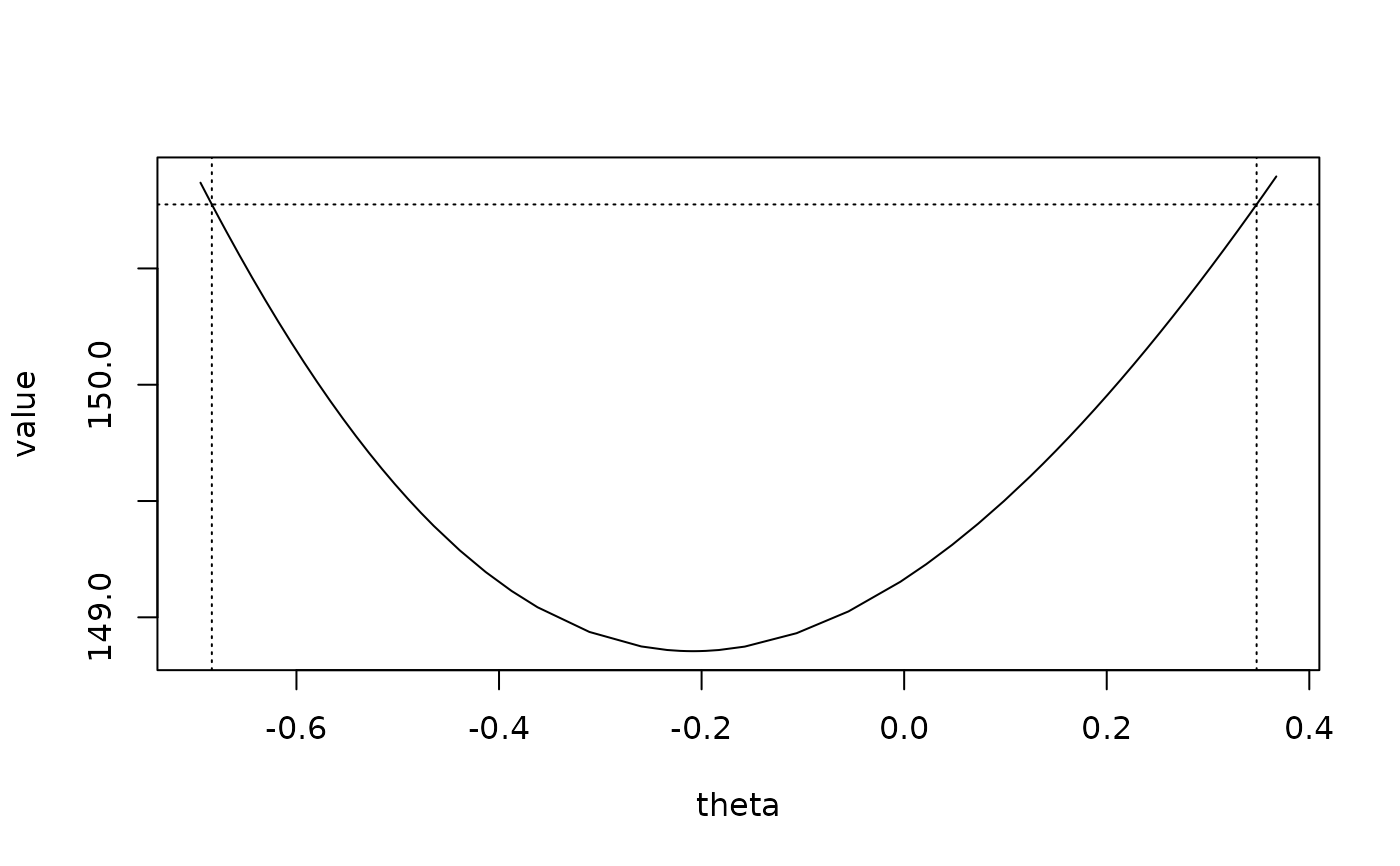 # TMB's confint() reads the interval off the profile
confint(pr)
#> lower upper
#> theta -0.6835298 0.3479822
# several parameters at once return a named list
prs <- profile(fit, c("x", "theta_1"))
names(prs)
#> [1] "x" "theta_1"