Extract random-effect modes
Usage
# S3 method for class 'frmtmb_fit'
ranef(
  object,
  summary = TRUE,
  robust = FALSE,
  probs = c(0.025, 0.975),
  pars = NULL,
  groups = NULL,
  ...,
  condVar = FALSE
)
Arguments
- object
A
frmtmb_fit.- summary, robust, probs
brms's arguments, in brms's positions so that a positional brms call asks the same question. brms answers
summary = FALSEwith the posterior draws androbust = TRUEwith their median and MAD, and a maximum-likelihood fit has no draws, so both are refused by name with the reason. The default of each is accepted and changes nothing.- pars
Optional coefficient names to keep, as brms's:
"x"keeps thexcolumn of every group, a dpar's included (sigma_x). A group left with no coefficient is dropped.- groups
Optional grouping factor names to keep. A name the model does not have keeps nothing.
- ...
Refused: an argument the method does not have is an error naming it, rather than silently changing nothing.
- condVar
If
TRUE, attach the conditional SDs of the modes (from the Laplace posterior) as a"condSD"attribute on each matrix, in matching layout.
Value
A named list of levels-by-coefficients matrices, one per
random-effect term, KEYED BY THE GROUPING FACTOR as brms and lme4
key it (so ranef(fit)$g and coef(fit)$g name the same group).
Each matrix carries its block label in a "term" attribute, which
is also the grp column of as.data.frame(). That long form
(with a condsd column when
condVar = TRUE was used) is what broom.mixed-style code reads.
Several terms on ONE grouping factor give several entries under one
name, and $ and [[ then take the block label instead:
ranef(fit)[["chi: 1 | id"]]. The bare factor name is refused
there, and names the labels, rather than returning the first block.
Positional indexing reaches every block either way.
Two ordinary spellings put more than one block on one factor, so
this is not a nonlinear-model corner: two bars written out on the
same factor, (1 | g) + (0 + x | g); and a random effect on more
than one distributional or nonlinear parameter, such as
bf(y ~ x + (1 | g), sigma ~ (1 | g)) (1 | g and
sigma: 1 | g) or (1 | id) on three nonlinear parameters. A
slope (1 + x | g) is one block, and so is an uncorrelated slope
(1 + x || g), as in brms; each is addressed by the factor name.
Examples
set.seed(1)
dd <- data.frame(x = rnorm(100), g = factor(rep(1:10, 10)))
dd$y <- rnorm(100, 1 + 0.5 * dd$x + rnorm(10, 0, 0.8)[dd$g], 1)
fit <- frm(bf(y ~ x + (1 | g)) + gaussian(), data = dd)

# one matrix per random-effect term, levels by coefficients
ranef(fit)
#> $g   (1 | g)
#>     Intercept
#> 1  -0.7929107
#> 2   0.1938151
#> 3  -0.6968770
#> 4  -0.3665206
#> 5  -1.2649301
#> 6   1.0458866
#> 7   0.8996913
#> 8   0.2424443
#> 9  -0.2011918
#> 10  0.9405934
#>
ranef(fit)$g[1:3, ]                 # keyed by the grouping factor
#>          1          2          3
#> -0.7929107  0.1938151 -0.6968770
attr(ranef(fit)$g, "term")          # the block it came from
#> [1] "1 | g"
ranef(fit)[["1 | g"]][1:3, ]        # or by that label
#>          1          2          3
#> -0.7929107  0.1938151 -0.6968770

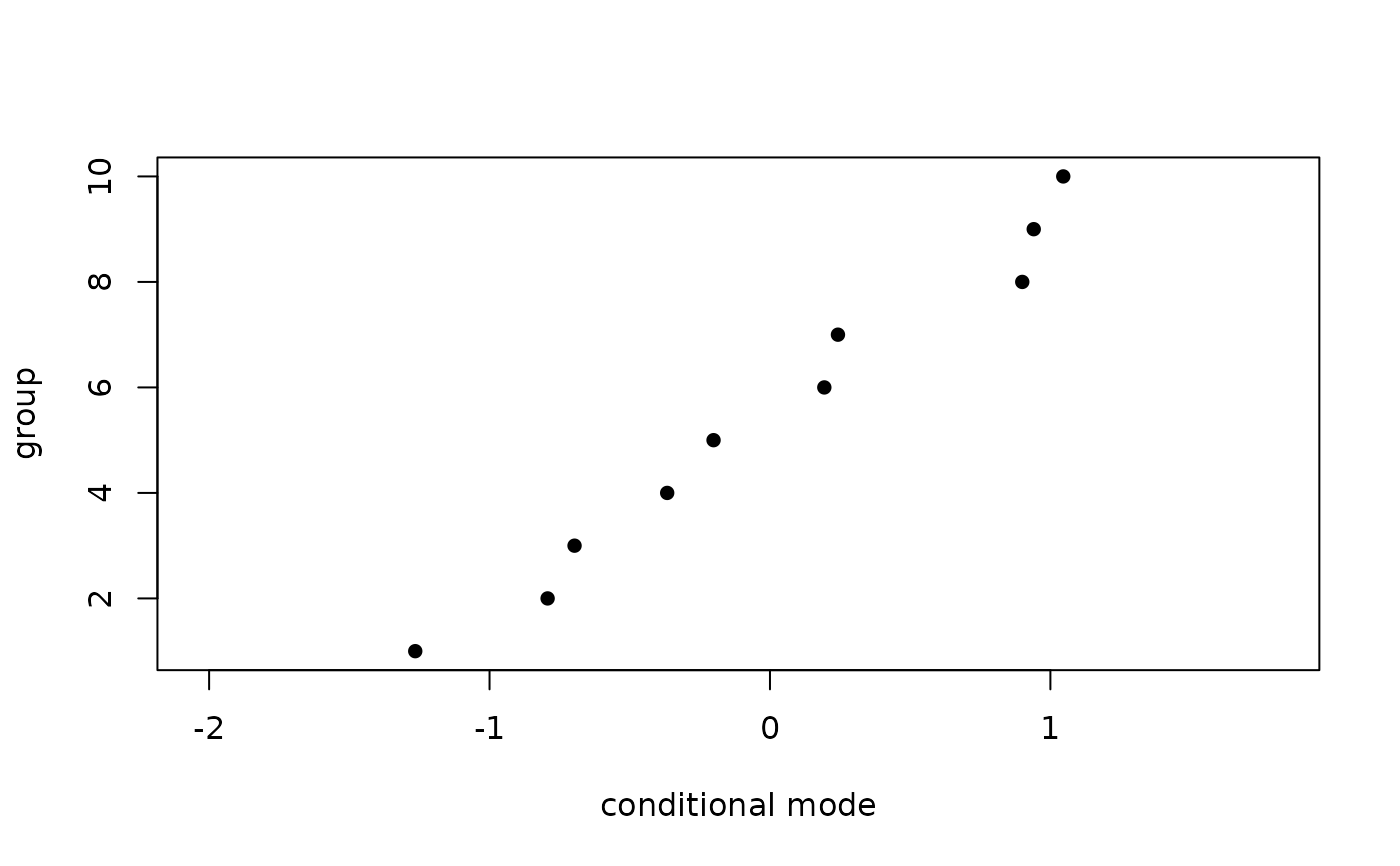
# condVar adds the conditional SDs a caterpillar plot needs
re <- as.data.frame(ranef(fit, condVar = TRUE))
head(re)
#>     grp      term level    condval    condsd
#> 1 1 | g Intercept     1 -0.7929107 0.3795349
#> 2 1 | g Intercept     2  0.1938151 0.3736803
#> 3 1 | g Intercept     3 -0.6968770 0.3773162
#> 4 1 | g Intercept     4 -0.3665206 0.3788816
#> 5 1 | g Intercept     5 -1.2649301 0.3829436
#> 6 1 | g Intercept     6  1.0458866 0.3798967
with(re[order(re$condval), ],
     plot(condval, seq_along(condval), pch = 16,
          xlim = range(condval - 2 * condsd, condval + 2 * condsd),
          xlab = "conditional mode", ylab = "group"))